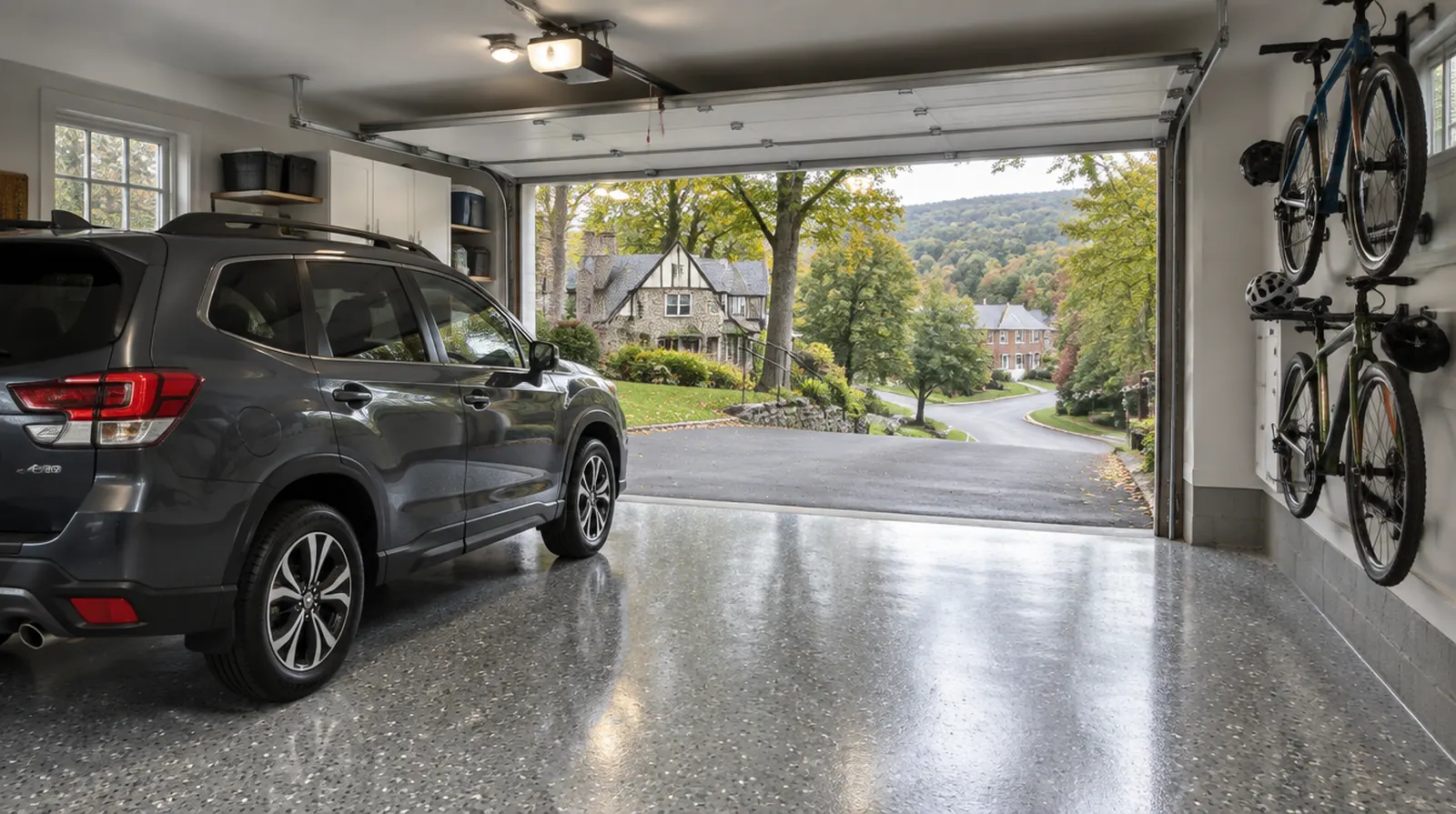
Why hillside garages are different
A tuck-under garage sits below the house, often with soil pressed against one or two of its walls. Rain that soaks into the hill above keeps moving down until it meets the foundation, and some of that moisture finds its way up through the slab as vapor. You might notice the floor stays darker near the back wall, or a white crust forms along the joint. Those are signs the concrete is breathing water. Coat it without a plan and the coating can blister or peel. Coat it with the right primer and you get a durable, attractive floor that stays bonded.
Our moisture-first approach
Every garage estimate includes moisture readings in several spots. We look for efflorescence, damp edges and old coatings that have bubbled. If the slab shows elevated vapor, we specify a moisture-mitigating epoxy primer that soaks deep and creates a tight barrier. It costs a bit more, but it is far cheaper than redoing a failed floor. For drier attached and detached garages, a standard penetrating primer does the job.
Grinding and repairs
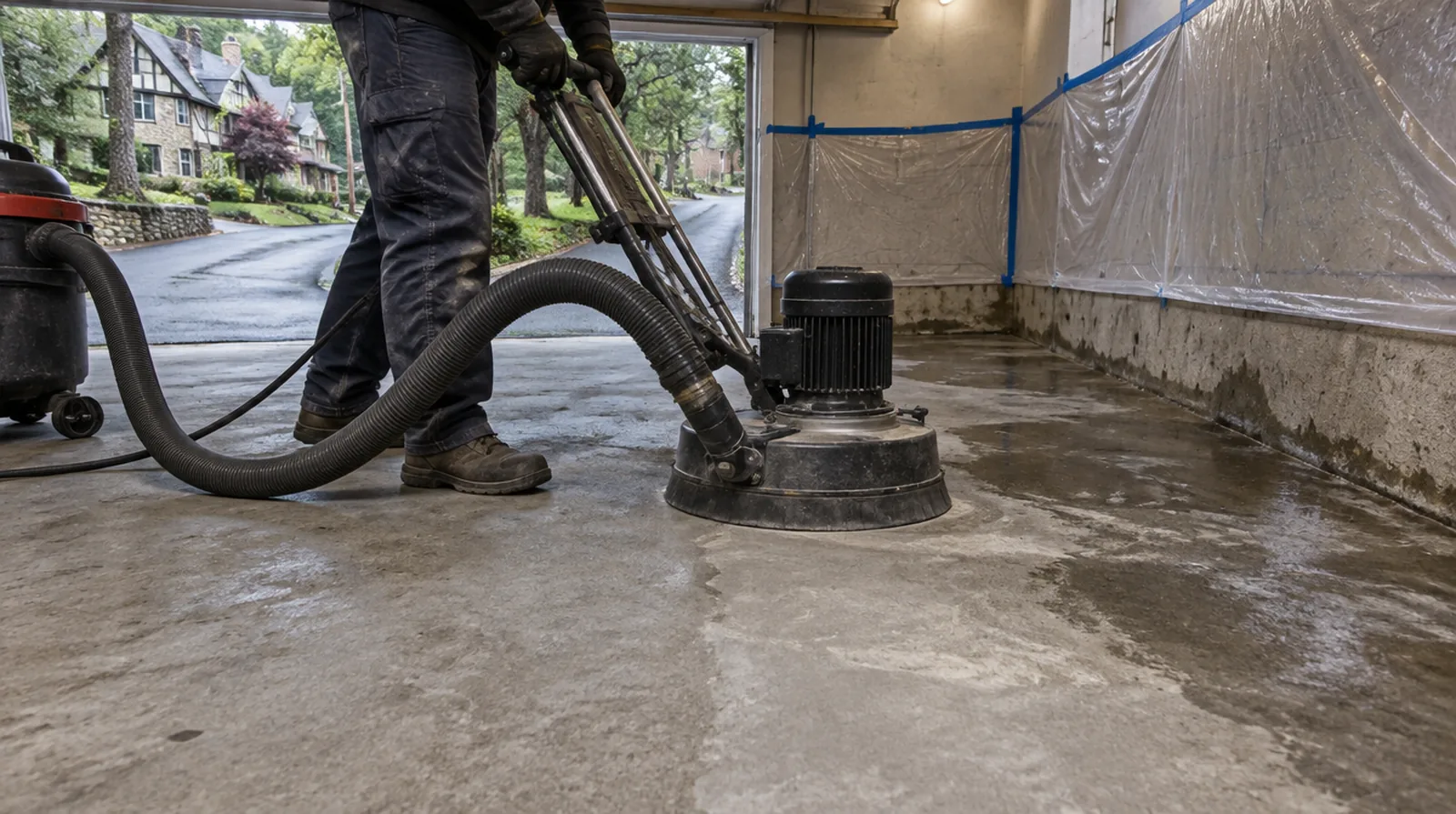
We never acid etch. Diamond grinding gives a consistent profile and removes old paint, sealers and contamination. Our grinders connect to HEPA dust extractors, which matters in a tuck-under garage where the house sits right above. After grinding, we fill cracks, patch spalls and rebuild the front edge of the slab where it meets the door seal. On steep driveways, that edge takes a lot of water and grit, so we make sure it is sound and sealed.
The coating system
- Primer: standard or moisture-mitigating epoxy, chosen from test results.
- Base coat: pigmented epoxy for color and build.
- Flake or solid: a full chip broadcast, a light sprinkle or a clean solid color.
- Topcoat: polyaspartic or urethane for scratch, chemical and UV resistance.
This multi-layer system is far thicker than a one-coat kit and holds up to hot tires, salt and heavy cars.
Narrow and older garages
Many older homes have garages built for cars from the 1920s and 1950s, which means tight widths and low ceilings. We plan around those limits with compact grinders and careful edge work. Stored items need to come out, and we can help plan where they go for a day or two. Detached garages at the end of long drives sometimes lack power, so we bring our own when needed.
Water at the door
Steep driveways funnel rain, snowmelt and road grit right to the garage door. If water regularly enters, we look at the door seal, threshold and trench drain. A coated floor can be pitched slightly at the threshold or paired with a new seal to reduce water entry. Texture near the door helps with traction when the floor is wet.
Timing and cure
Most garages are finished in one to two days. Foot traffic is usually fine by evening of the last day, and cars can return after one to three days depending on temperature and products. In cold months, we use heaters and faster-curing materials. In humid summer weather, we manage ventilation and start early to avoid issues.
What drives the price
Cost depends on garage size, slab condition, moisture levels and the chosen finish. A tuck-under garage with high moisture and lots of patching will cost more than a newer, dry slab. Your estimate breaks out each step so you know exactly what you are paying for.
Pairing with other services
Many customers add a driveway treatment or sealed front steps at the same time. If your current garage coating is failing, our repair service explains how we remove it and start fresh.
to coat your garage.
Call (973) 520-0632 for a free estimate.